Pioneer of Fluid Art Movement
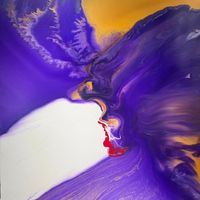
Kenneth was the third known artist to work in this stye of abstract art. Over 60 years he perfected his "Controlled Chaos" with his style, giving purpose to the movement of paint to create his abstract masterpieces.
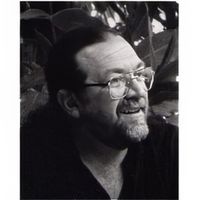
Artist Kenneth Moore
To understand Kenneth, you almost have to start before him. In 1936, David Alfaro Siqueiros introduced what he called ‘accidental painting’ using industrial materials. Then in the 1940s, Jackson Pollock pushed that even further—turning movement itself into art.
Kenneth comes out of that lineage… but what makes him different is that he didn’t just embrace the chaos—he learned how to control it.
He began developing his process in 1967 at the University of Texas, and then spent the next six decades refining it.
This wasn’t a phase or a style—this was a lifetime of work. He engineered his own blends of acrylic emulsions, adjusting viscosity, temperature, and environment so the paint would move exactly how he wanted it to.
What’s really unique is how far he took that exploration across different mediums.
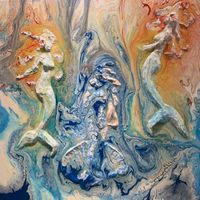
You’ll see his abstract acrylic on canvas, which is where that fluid movement really comes alive.
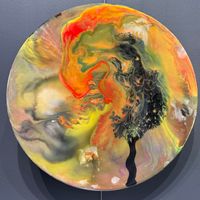
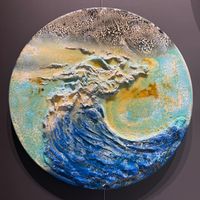
He also created an abstract acrylic on wood series called the ‘Portal Series’—those pieces have a different energy… almost like you’re looking into something rather than at it.
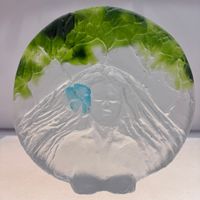
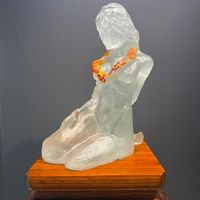
And then on the sculptural side, he mastered cire perdue—lost wax casting—creating Belgian crystal sculptures. Those works carry the same sense of flow, but in a completely dimensional form.